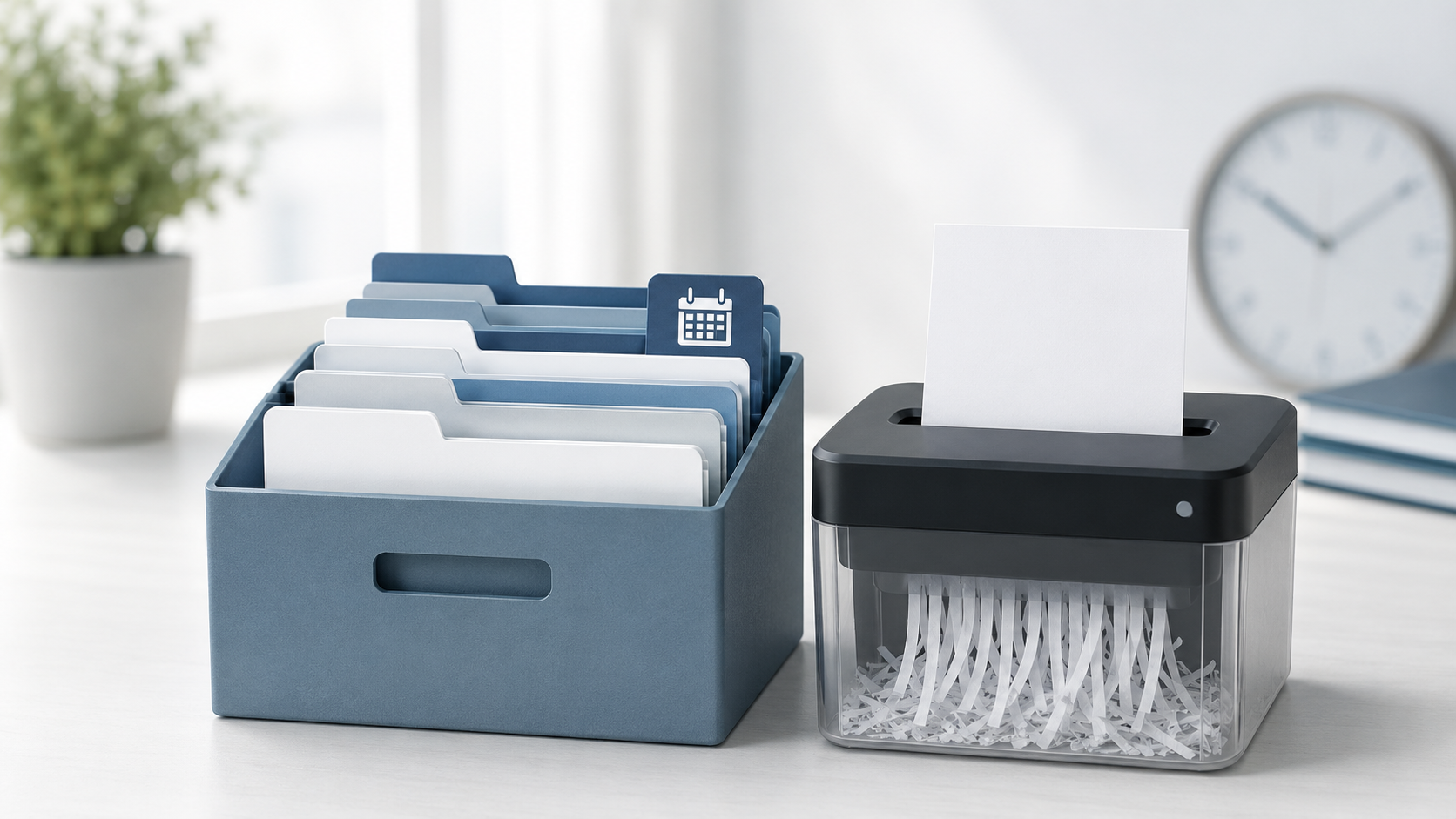
Most businesses handle document retention one of two ways: keep everything indefinitely because it feels safer, or shred in a burst of motivation once a year when the file room gets too full. Neither one is actually a retention policy, and both create real exposure — one from holding onto sensitive records far longer than any regulation requires, the other from the risk of shredding something you legally needed to keep.
A real retention schedule isn’t complicated, but it does require knowing roughly how long different types of records actually need to stick around.
A General Starting Point by Record Type
Retention requirements vary by document type, industry, and state, so treat the following as general starting points rather than a compliance guarantee — when a specific document matters for a pending dispute, audit, or regulation, it’s worth confirming the exact requirement with your accountant or attorney.
- Tax returns and supporting documentation: Generally 3 years from filing, though the IRS recommends up to 7 years in situations involving a loss from worthless securities, a bad debt deduction, or an amended return
- Payroll records and pay stubs: Typically at least 3 years under federal wage and hour law, though many businesses retain longer for audit purposes
- Employment eligibility (Form I-9): 3 years after the date of hire, or 1 year after termination, whichever is later
- Bank and credit card statements: About 1 year, longer if tied to a tax deduction or ongoing dispute
- Contracts and legal agreements: For the life of the agreement, plus your state’s statute of limitations for written contracts after it ends
- Client and customer records: Varies widely by industry — healthcare, legal, and financial services all carry their own specific retention rules
Why “Shred Everything Eventually” Isn’t a Policy
The problem with an informal approach isn’t usually the file room getting cluttered — it’s the inconsistency. If records get destroyed whenever someone gets around to it, there’s no way to prove, during an audit or a legal dispute, that destruction happened on a defensible schedule rather than conveniently after a document became inconvenient. And if nothing gets shredded until the cabinet is full, expired records with real value to an identity thief sit around for years longer than they need to.
A retention schedule solves both problems at once: it sets a defined point at which a record’s required holding period ends, and a defined process for what happens next.
Where Scheduled Shredding Fits In
This is exactly the gap Richards & Richards’ regularly scheduled shredding subscriptions are built to close. Instead of a one-time cleanout, locked collection bins stay on-site and get emptied on a set cadence — weekly, bi-weekly, monthly, or a custom schedule built around your retention timeline.
Every pickup is handled by uniformed, background-checked drivers, documents are shredded on industrial-grade equipment, and you receive a Certificate of Destruction after each service. That certificate is what turns “we shred things periodically” into a documented, auditable process that supports HIPAA, FACTA, and GLBA compliance instead of just assuming it.
The schedule isn’t fixed in stone, either — frequency can be adjusted as your document volume or retention needs change.
Getting Started
If your business is currently relying on an annual cleanout (or no schedule at all), the retention periods above are a reasonable starting point for deciding what needs to be kept and for how long. From there, a regularly scheduled shredding subscription turns that schedule into an actual routine, with the documentation to back it up.
Call 615-242-9600 or request an estimate online to set up a pickup schedule that matches how your records actually need to be handled.